

The Al-Aqsa Mosque in Jerusalem holds spiritual and historical value which extends beyond Muslim communities to people around the world. This site, which stands at the center of the Temple Mount, serves as the third most sacred Islamic site which Muslims consider after their two holy cities of Mecca and Medina. The site holds major religious significance because Muslims believe Prophet Muhammad ascended to heaven from this location during his Isra and Mi'raj journey. The Al-Aqsa Mosque operates as a religious space which demonstrates how Jerusalem's cultural and religious history developed in a city that all three Abrahamic faiths share. Al-Aqsa Mosque, with its beautiful buildings and holy outdoor spaces and its long-standing historical significance, serves as an essential destination for worship and meditation and pilgrimage, attracting numerous visitors each year who visit the Holy Land to see other religious sites in the city.
The Significance of Al-Aqsa Mosque in Islam
A Sacred Center of Faith
Al-Aqsa Mosque stands as a central element of Islamic faith and worship. Islamic tradition maintains that this mosque served as the final destination of Prophet Muhammad's miraculous night journey from the Kaaba in Mecca to the celestial realm known as Isra and Mi'raj. The journey included Muhammad's interactions with some of the previous prophets and receiving directives from Allah, highlighting Al-Aqsa and its ensuing sanctification.
The First Qibla in Islam
Muslims focused their prayers at Al-Aqsa in Jerusalem for the Qibla during the early times of Islam-right up to the founding of prayer in Mecca. Because Muslims showed deep religious affinity with Jerusalem and Al-Aqsa after the shift, the mosque subsequently maintained its sacred importance.
A Symbol of Unity and Worship
Muslims find deep spiritual significance in their Al-Aqsa visits. Muslims consider Al-Aqsa prayers to be highly valuable although they do not need to perform them as a mandatory duty like Hajj at Mecca. The Prophet Muhammad established this teaching through the Hadith which states people should travel only to three mosques: Al-Masjid al-Haram in Mecca and Al-Masjid an-Nabawi in Medina and Al-Aqsa.
A Space of Peace and Contemplation
Al-Aqsa Mosque functions as more than a building because it presents a space that brings peace to people who dedicate themselves to Allah through their worship. The building has functioned as a location for religious activities and educational purposes and community events since its establishment. The mosque provides a space where Muslims worldwide can reflect on their spirituality which establishes their connection to their faith and each other as members of the global ummah.
Cultural and Political Weights
More than an historical relic, Al-Aqsa Mosque depends on very vital political and cultural influences, particularly within the Palestinian perspective. The mosque and its compound have been used to convey ethnical and heritage status on the map while serving as symbols of resistance to the Gaza Stripwards of the Israeli-Palestinian conflict. Issues of global concern-precisely those for Muslims and the protection of cultural and religious rights-prove to be essential regarding the preservation of the mosque as a public place.
Architectural Wonders of Al-Aqsa Mosque
The Dome
The mosque's gray dome stands as an essential element which showcases Islamic artistic development throughout multiple centuries. The dome's design shows simple beauty which matches the golden Dome of the Rock while it enhances the peaceful beauty of the compound. The dome structure together with the adjacent courtyard and arcade spaces creates a peaceful and beautiful space.
Courtyards and Arcades
One of the main components of the mosque's architecture is the spacious courtyards and the domed porticoes. They provide shady and private spots for worshiping in splendorous architectures of beautifully ornamented pillars and arches that convey a tint of Islamic art to the regional architecture.
The Prayer Hall
The interior of Al-Aqsa has been designed to incite contemplation and devotion. Its vast prayer hall can accommodate thousands and features high vaulted ceilings, intricate mosaics, and elegant calligraphic inscriptions of the Islamic kind. The geometry of the patterns and richly adorned carpets enhance the conduction of prayer and meditation.
Dome of the Rock Relationship
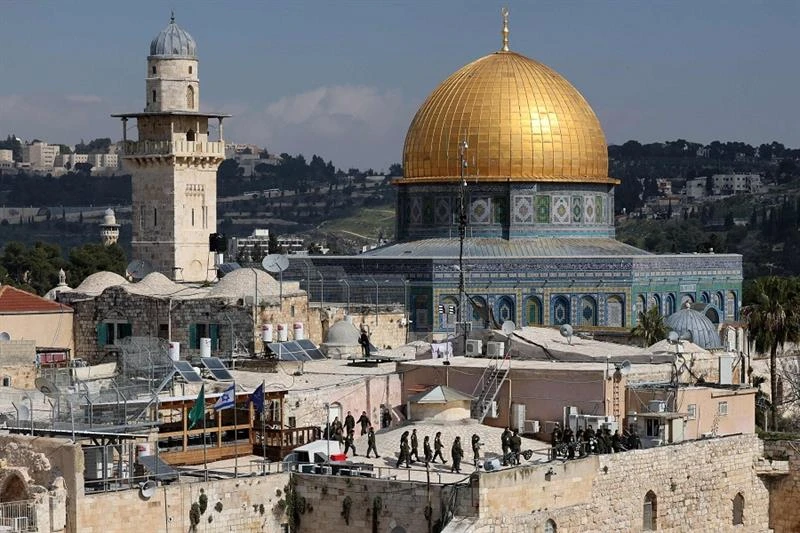
Although Dome of the Rock falls short of being a mosque, it forms an integral part of the Al-Aqsa compound. Together, these two structures promise a very strong integration in both spiritual and visual artistry combining architectural appeal with a high level of religious significance.
Historic Layers
It is an architecture that, completing the Al-'Aqsa layers of history, mainly echoes the various Islamic dynasties, including- Umayyad, Abbasid, Fatimid, Ayyubid, and Ottoman, besides very strong Byzantine and Crusader influences.
Minarets and Outer Wall
By towering over the complex in courteous proportion, the bright minarets of the mosque balance functionality and decoration. The pale stone walls worn by the weather and intricately carved designs meticulously crafted by generations gone by.
Journey Through Al-Aqsa: Insights for Visitors
The Main Idea for Understanding
It is very important to remember to show the respect to Muslims regarding the al-Aqsa Mosque and its associated significance. According to Muslim belief, the al-Aqsa Mosque was in their Prophet Muhammad's miraculous night journey. Embracing a broader understanding of shared heritage, this Mosque promotes an emphasis on the roots of all these three religions in a single city - that is Jerusalem.
Access To Reach Al-Aqsa
In general, Muslims can come for their prayers at al-Aqsa at all times. However, due to security reasons, non-Muslim visitors are expected to follow a "normal" visit appearance in specific hours. Visiting on a weekday and avoiding Fridays will make your visit more peaceful.
Dress Code and Behavior
Modest attire is required. Men should wear long-sleeved shirts and pants, while women should cover their arms, legs, and hair. Respectful and quiet conduct is essential to preserve the sanctity of the mosque.
The Al-Aqsa Compound
Another part of the larger Haram al-Sharif, this mosque, perhaps as an extension, is set alongside the Dome of the Rock and al-Marwani Mosque. Visitors normally respond to them with an attitude of deepest respect, surrounded by the great architecture, placid courtyard, and numerous consecrated spaces.
Security Measures, as well as Guided Tours
Security screenings are seen to be severe enough because of the importance of this place. Guided tours are offered, which may be of help in understanding the historical times of the mosque, its meaning and spiritual value and the architectural gems that this mosque can offer much greater revelations than a simple visit on one's own.
The slowness and the beauty of Al-Aqsa, along with its sanctity and layers of history, have made them among the most cherished spots on Earth. The importance of this structure exceeds the Islamic, reflecting further centuries of shared humanity and intertwined faiths of Jerusalem. Visiting these sacred premises provides a lasting moment of religion, meditation, and cultural discovery, making it one of the imperative aspects of the Holy Land journey.
--webp.webp "5-Day Islamic Holy Land Tour Package")

-webp.webp)
-webp.webp)

-webp.webp)